


In this issue:
A four-step public capitulation by the most-funded AI SDR company, landing in February with a16z’s own partner walking back the ARR narrative.
The structural cost of buying replacement automation when buyers were actually paying for signal.
What to audit in your outbound stack before the next board review.
The disclaimer that wasn’t a warning
On February 5, 2026, Jennifer Li went on the TechCrunch Equity podcast and said something her firm hadn’t said before. Li is a general partner at Andreessen Horowitz, where she oversees the $1.7 billion AI infrastructure fund. Her portfolio includes Cursor, ElevenLabs, Fal.ai. She is, by any measure, one of the people pricing the AI category right now.
Her line: “Not all ARR is created equal, and not all growth is equal either.” Be skeptical, she added, of any founder announcing spectacular revenue on X. Especially when the number arrived fast.
She named no one. She didn’t have to.
Fourteen months earlier, in November 2024, the same firm had led a $50 million Series B in 11x, the AI SDR company building Alice. The round closed at a $320 million valuation. 35x annualized revenue multiple. The pitch on every fundraising deck: AI workers that replace your SDR team.
This is a story about what happens between those two moments.
Four steps, each louder than the last
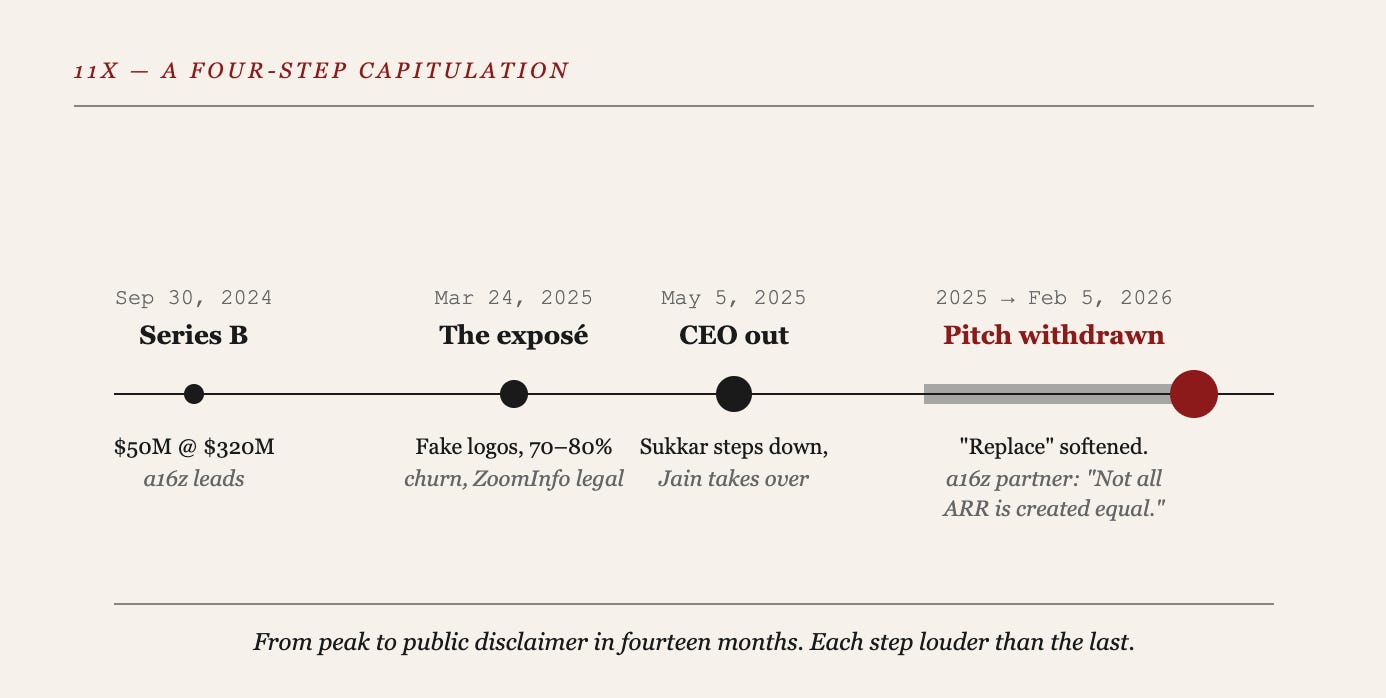
Step one was the peak. On September 30, 2024, TechCrunch broke the Series B leak. Two weeks earlier, Benchmark had announced 11x’s $24 million Series A. Now Andreessen was in for $50 million more. Two funding announcements, fourteen days apart, for a single sales tool.
Founder Hasan Sukkar told TechCrunch the company was “approaching $10 million in annual recurring revenue.” That’s the math that made the valuation work — and the math the rest of the story is about.
Step two was the factual collapse. On March 24, 2025, TechCrunch published the exposé. ZoomInfo and Airtable, two of 11x’s marquee logos, had never been customers. ZoomInfo had run a one-month trial, found the product “performed significantly worse than our SDR employees,” and churned. The logo stayed on 11x’s website for the next year. ZoomInfo’s lawyer threatened action over deceptive trade practices.
The ARR number also came undone. 11x sold annual contracts with three-month break clauses, then counted the full year as ARR even after customers walked at month three.
Former employees told TechCrunch the company was “losing 70-80% of customers that came through the door.” Of a reported $14 million in ARR, roughly $3 million survived past the trial window.
Step three was the leadership collapse. Six weeks later, on May 5, 2025, Sukkar stepped down as CEO.
Bloomberg framed it directly: a move that follows critical reporting about the company. Prabhav Jain, the CTO and a former Brex executive, took over. Sukkar moved to non-executive chairman - the kind of title that says we needed him gone but not entirely gone. Seven months earlier, his face was on the Series B announcement.
Step four arrived in increments through 2025 and into early 2026. Under Jain, 11x quietly pulled back on the replacement framing. The public messaging started leaning toward augmenting SDRs instead of replacing them. No press release. No founder statement explaining the shift. Just the slow erosion of the original promise across product pages, sales calls, partner messaging.
By February 2026, when Jennifer Li sat down with the Equity podcast, all four steps had already happened. The firm she works for had priced the category at $320 million on a narrative that the company couldn’t defend a year later. Li’s “not all ARR is equal” wasn’t a warning. It was a retroactive disclaimer.
Not an 11x bug. The category.
It would be easy to read this as 11x’s problem. It isn’t.
UserGems published category-level benchmark data in 2026: 50 to 70 percent of AI SDR contracts churn before first renewal. Salesmotion confirmed the same range in February. The AI Corner in March. Reddit’s r/coldemail at the community level. Four independent sources, one number. AI SDRs are losing more than half their customers inside twelve months. This is the math of the category, not the failure of one vendor.
In June 2025, Gartner had already called it. The firm forecast that more than 40 percent of agentic AI projects will be canceled by the end of 2027. Senior Director Analyst Anushree Verma named the term: agent washing. Out of thousands of vendors marketing themselves as agentic AI, Gartner estimated only about 130 were genuinely agentic. The rest were rebranded chatbots and RPA tools.
Verma was specific about the failure mode. The projects don’t fail because the agents don’t work. They fail because humans deploying them are making the wrong decisions. The buyer was misled about what they were buying. That’s the structural finding.
So here’s the buyer-side math nobody on the vendor side wants to publish.
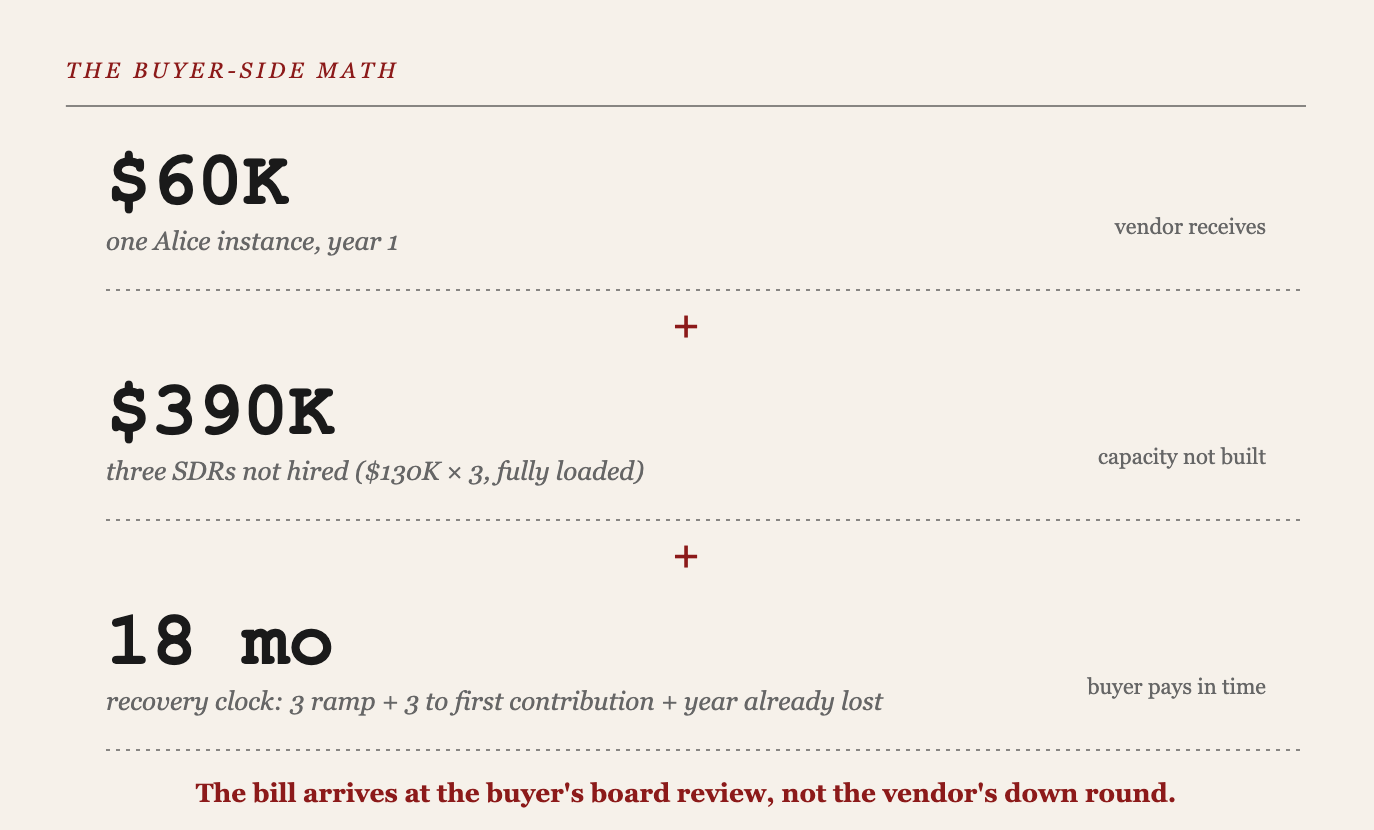
The contract: $60,000 per year for one Alice instance.
The team not hired: three SDRs at $130,000 fully loaded, each. That’s $390,000 in human pipeline capacity the buyer didn’t build because the AI was supposed to replace it.
The recovery clock: three months of ramp plus three months to first productive contribution. Six months before quota comes back. And the quota for 2026 was set assuming the AI SDR worked.
It didn’t. So now the bill arrives.
The bill the vendor doesn’t pay
The bill is not the $60K contract. The vendor got that money in Q1. The bill is the eighteen months between signing the AI pitch and rebuilding the human pipeline behind it. The Q1 numbers that came in soft. The hiring plan that has to be revised before next quarter’s board meeting. The forecast that no longer matches the model the round was raised on.
The vendor is fine. They got their cash. The investor is fine. They wrote off the position internally months ago and Jennifer Li is now publicly distancing from the metric they paid for. The buyer is the one explaining it to their board.
This is what a category admits when it can no longer afford to sell what it sold. The dealer is signaling.
Three audits before your next board review
One: pull cohort retention by signed-month. Not blended ARR. Cohort. Pick every AI vendor in your stack - outbound, customer support, internal workflows - and graph what percentage of customers signed in any given month are still active at month 3, month 6, month 12. If the curve drops below 60% at month 6, you have a vendor problem and a budget conversation. Run this before someone in your next funding round runs it for you.
Two: stress-test the pitch-product gap. For every AI vendor in your stack, write down the headline promise their salesperson used. Then write down what your team actually uses the product for. If the two sentences are different, you have a sourcing problem disguised as an execution problem. The bill on that gap doesn’t compound in the vendor’s revenue. It compounds in your missed quota.
Three: read the dealer signals. When the firm that priced an AI category publicly distances from the metrics they paid for, that’s not commentary. That’s an internal portfolio mark-down arriving in your news feed. The next two AI SDR vendors to lose a CEO inside twelve months of Series B will tell you whether this is a 11x story or a category story. The category data already says category.
What’s in it for you
You’re a founder who closed a round in 2024 or 2025 on an AI-adjacent pitch. Your outbound stack has at least one autonomous-agent vendor in it. Your Q1 numbers came in soft and you’re not yet sure why. This issue gives you the language for what you’ve been sensing.
The thing you can do this week: pull your cohort retention curve, segmented by signed-month, for every AI vendor in your stack. Not next quarter, this week. If the curve looks worse than your blended ARR suggests, you have ninety days to revise your forecast cleanly. After that, you’re revising it in front of your board.
The 11x story isn’t a morality tale. It’s a buyer’s math problem with a sixteen-month publication lag. Some of you are in month nine.
The buyer paid for signal. The vendor delivered automation. The gap is what closed the pilot before it closed the renewal.
If your sourcing is the bottleneck and your reps aren’t, no AI SDR contract you sign in 2026 is going to fix it. The fix is signal infrastructure your team owns — buying intent layer, scoring model, outbound system, transferred over and operated by your people after twelve weeks. Not a retainer. Not a longer contract with a different vendor selling you the same pitch.
That’s the architecture I build at TrendLoom. Done-with-you, 8-12 weeks, end to end. Founding rate for the first three clients: $10-12K setup, $1.5K/month for ongoing support. The methodology is built around buying signals that predict purchase intent — funding events, hiring patterns, technology shifts, persona context — not better automation on the wrong list.
If the four signals in this post made you uncomfortable, that discomfort is the right reaction.
Sources for the article - full reference list
[1] Jennifer Li, TechCrunch Equity podcast, published Feb 5, 2026. Link.
[2] Bloomberg, “Andreessen Leads $50 Million Funding in AI Startup 11x,” Nov 11, 2024. $320M valuation. Link.
[3] TechCrunch, “11x.ai has raised $50M Series B,” Sep 30, 2024. Sukkar quote on ARR. Link.
[4] TechCrunch, “11x has been claiming customers it doesn’t have,” Mar 24, 2025. Source for ZoomInfo / Airtable / “Contracted ARR” / 70-80% churn / legal threat. Link.
[5] Bloomberg, “CEO of Andreessen Horowitz-Backed AI Startup 11x Steps Down,” May 5, 2025. “A move that follows critical reporting about the company.” Link.
[6] UserGems 2026, cited via Autobound’s AI SDR buyer’s guide. Link. Independent confirmations: Salesmotion (link) and The AI Corner (link).
[7] Gartner press release, “Over 40% of Agentic AI Projects Will Be Canceled by End of 2027,” June 25, 2025. Anushree Verma; “agent washing.” Link.
[8] Landbase, “11x.ai Pricing 2026.” Link. Confirmation: Prospeo. Link.
[9] Salesmotion, citing Bridge Group SDR Metrics Report 2025 and Pavilion 2025 Sales Compensation Study. Link.
[10] SalesHive, “The True Cost of an SDR,” Dec 20, 2025. Link.